Showing posts with label patrick mccaskey. Show all posts

Thursday, June 10, 2021

Guy Chamberlin, Pillar of the NFL


Guy Chamberlin Illustration by Bill Potter,
Copyright 2014, Sporting Chance Press

Guy Chamberlin

Hall of Famer Guy Chamberlin was a peerless defensive end, excellent rusher, and receiver from the University of Nebraska.  He played for the Staleys/Bears in 1920 and 1921.  His contributions to the 1921 championship were essential to the Bears’ success. Chamberlin, like George Halas was a player-coach for much of his playing career. He coached four NFL Championship Teams. Chamberlin was one of the very best athletes in the first decade of professional football.  Halas regretted not keeping Chamberlin in Chicago in 1922.  Chamberlin was an All-Pro. He was inducted into the Pro Football Hall of Fame in 1965.

 New Sporting Chance Press Football Book:

PAPA BEAR AND THE CHICAGO BEARS’ WINNING WAYS reviews the exciting story of George Halas and his dynamic role in professional football for Middle Grade and older students. Just $7.76 on Amazon today!

Friday, May 21, 2021

Papa Bear and the Chicago Bears' Winning Ways: Wisdom of George Halas, a Pillar of the NFL

sportingchancepress.com

Readers of the Pillars of the NFL by Patrick McCaskey know that George Halas is one of the 10 most successful coaches in NFL history. In fact, the first chapter of Pillars of the NFL was focused on Halas and what a great contribution he made not only to the sport of football, but to our country. 


Patrick McCaskey and Friends
Certainly in these times of uncertainty, it also made perfect sense to produce a book on Halas for younger readers and discuss Bears history and distill the wisdom of the great coach. Halas was a motivator, but he was necessarily focused on the Bears and professional football. But with Patrick McCaskey, grandson of George Halas, we had an opportunity to examine the "winning ways" of Halas from someone who knew him very well. Our book, PAPA BEAR AND THE CHICAGO BEARS' WINNING WAYS does just that and more. 

PAPA BEAR AND THE CHICAGO BEARS' WINNING WAYS reviews the exciting story of George Halas and his dynamic role in professional football. Halas who was present in the first days of the National Football League (NFL) all the way into the modern age of football. Author Patrick McCaskey, is a Chicago Bears Vice President and Director. McCaskey highlights his grandfather's life with key events from the 20th century. McCaskey follows Halas as a student, athlete, soldier, coach, team owner—a man of commerce and community. 

Halas’s 20th century path is laid out before readers. PAPA BEAR AND THE CHICAGO BEARS' WINNING WAYS includes some of the coach’s important words of wisdom that young people need today to achieve success. These “winning ways” are used in exercises that were originally devised by Ben Franklin that readers will find helpful and interesting. A glossary, special exercises, a quiz and discussion questions help readers expand their interest and learning experiences. Readers are taken on a short journey through history that helps them expand their understanding of our world. The book introduces Halas quotes and the methods of one of America’s founding fathers and original self-help gurus, Ben Franklin.

PAPA BEAR AND THE CHICAGO BEARS' WINNING WAYS is a middle grade book that readers age 12 and over will enjoy. With many photos and illustrations, it should appeal to reluctant readers as well.  

AMAZON NOW OFFERS PAPA BEAR AND THE CHICAGO BEARS' WINNING WAYS AT A REDUCED PRICE. 


Monday, April 5, 2021

The Great Don Hutson: Pillars of the NFL by Patrick McCaskey


sportingchancepress.com

This post was published in Pillars of the NFL by Patrick McCaskey and is Copyright Sporting Chance Press:


Don Hutson 


Joining the Packers in 1935 was Don Hutson, a receiver who would go on to break many NFL records in his 11-year Packers’ career.  He ran excellent routes—some that he had devised himself.  He had subtle moves that fooled defensive players.  After playing against Hutson, run-oriented coaches would experience firsthand what the passing game might provide given the right personnel.  

Hutson was in a league by himself—he led the NFL nine times in touchdown receptions.  In 1942, his 17 touchdown receptions eclipsed the old record by 8 scores.  Hutson was also the first receiver to break 1,000 yards when he gained 1,211 that same year. 

[Curly] Lambeau scouted Hutson at the Rose Bowl played on January 1, 1935.  Hutson’s Alabama team defeated Stanford 29–13.  Hutson scored two touchdowns that game and afterwards many teams were in hot pursuit of the young receiver.  

Shipwreck Kelly, owner of the Brooklyn Dodgers, had the inside track after assuring Hutson he would match any offer.  However, Lambeau convinced the Hall of Famer Hutson to sign a contract with the Packers when Kelly was nowhere to be found.  Immediately after signing the Packer contract, Kelly showed up at Hutson’s doorstep. Kelly convinced Hutson to sign a Dodgers’ contract and allow NFL President, Joe Carr, to settle the issue.  Carr ruled in favor of Green Bay, which was a good move for football given Lambeau’s desire to develop a strong passing game that would use Hutson’s talent.

According to Hutson, Lambeau paid him $300 a game, but the coach was concerned about the rest of the players learning the salary so he paid Hutson in two checks and asked him to cash each one at different banks in Green Bay.33  Hutson and Lambeau got along well throughout their entire lives.  Lambeau’s preseason preparations and his more disciplined, back to basics approach would pay dividends.  The Packers improved to second place in 1935 with an 8–4 record.  

33 Richard Whittingham, What a Game They Played: An Inside Look at the Golden Era of Pro Football, 122. 

The Packers outscored their opponents by 85 points for the season. In the early days of professional football, players often played a full 60 minutes a game and the same position on offense and defense.  Thus an end would play offensive end and then turn around as defensive end as well.  Lambeau is credited with modifying this strategy and thereby extending Hutson’s career and effectiveness.  Lambeau used Hutson as a defensive back later in his career and used a more durable blocking back to play the physically demanding defensive end position.  
************


Wednesday, December 9, 2020

McCaskey's Poems About the Gospel


Patrick McCaskey's Poems About the Gospel has "hit the streets." If you have seen Pat's live presentations, you know he is a gifted creative writer and he often recites his work. Pat's Poems About the Gospel includes 150 works that focus on specific writings of the Evangelists: Matthew, Mark, Luke, and John. Each poem zeroes in one or more critical truths. I like to think the poems are faith distilled in only Pat's way of doing it. McCaskey is a humble and humorous man and that certainly comes out in his poems.  

The works in Poems About the Gospel are often surprising and humorous. They are the works of a modern man whose faith in one that is as alive today as ever regardless of the directions taken in today's often faithless culture. Truth comes out in the end and McCaskey demonstrates a faith  that is strong and secure. And Pat does very little without a sense of humor, so here or there in the poems readers will find a laugh, often the self deprecating variety. 


Tuesday, December 8, 2020

Sporting Chance Press Publishes McCaskey's Fifth Sports and Faith Book in 2020


I
n 2020,  Americans fought hard times. It was an uphill climb and is still going on this month as we are seeing plans to start administering vaccines for the general public to defeat the Coronavirus. It was a pleasure to publish four books at Sporting Chance Press this year and those efforts kept me close to home. 

Our first book this year was Sportsmanship, which was our fifth book in the Sports and Faith Series. Author Patrick McCaskey, Vice President of the Chicago Bears, lives a life that is one of sports and faith. Working with the Chicago Bears Football Club, managing programs that honor exemplary players and coaches, participating in charitable events and programs that give back to the community, and much more are all part of Pat's existence. I can't think of anyone better to write about sports and faith than Pat. 

Besides stories of players, coaches, and contests, Sportsmanship includes a literary portion that features a section on the author's favorite authors, a collection of his Biblical-inspired poems, and a collection of speeches that he has given over the years. Certainly, those who have seen McCaskey in person these past many years will find these works a valuable keepsake.

Who is author Pat McCaskey? McCaskey is a grandson of Papa Bear George Halas, a brother of Chicago Bears Chairman George McCaskey, and son of the guiding spirit of the Bears today, Virginia McCaskey.  McCaskey has been working for the Bears for over 45 years and he is the Chairman of Sports Faith International and Catholic Radio WSFI. 

Image: James Thurber House released to public domain by Nyttend. 

Friday, November 6, 2020

Inspired by Pillars of the NFL: Papa Bear Book for Kids


As a publisher if you are doing things right, every book you produce has some connection to others you've done. Pillars of the NFL is certainly a book that I love as much as a book reader as a publisher. Written by Patrick McCaskey, Pillars is a classic that should be in every football fan's library. A crazy amount of research went into Pillars and it was not easy, although quire rewarding.  

In Patrick McCaskey's Sports and Faith Series, he also talked about some NFL Pillars in those books. And now we are producing a new series for middle grades and older that we are calling our Winning Ways Series. Papa Bear and the Chicago Bears' Winning Ways takes things from our Sports and Faith Series and the Pillars of the NFL. 

PAPA BEAR AND THE CHICAGO BEARS' WINNING WAYS reviews the exciting story of George Halas and his dynamic role in professional football. Halas who was present in the first days of the National Football League (NFL) all the way into the modern age of football. Author Patrick McCaskey, a Chicago Bears Vice President and Director, is a grandson of Papa Bear George Halas. McCaskey highlights his grandfather's life with key events from the 20th century. McCaskey follows Halas as a student, athlete, soldier, coach, team owner—a man of commerce and community. Halas’s 20th century path is laid out before readers. PAPA BEAR AND THE CHICAGO BEARS' WINNING WAYS includes some of the coach’s important words of wisdom that young people need today to achieve success. These “winning ways” are used in exercises that were originally devised by Ben Franklin that readers will find helpful and interesting. A glossary, special exercises, a quiz and discussion questions help readers expand their interest and learning experiences. Readers are taken on a short journey through history that helps them expand their understanding of our world. The book introduces Halas quotes and the methods of one of America’s founding fathers and original self-help gurus, Ben Franklin.


Specifications:

5.5 x 8.5 paperback,

130 pp., ISBN:

9781734586312

With illustrations, 

learning aids, TOC, 

and topical index. 


Friday, March 15, 2019

Papa Bear and the Chicago Bears Winning Ways

A Look at Papa Bear
As we are coming up to the new football season. First the draft and then before you know it, it will be training camp. It's a great time to remind readers that we have a small book that has tremendous value for kids that we have available as an eBook on Kindle. It is called Papa Bear and the Chicago Bears’ Winning Ways by Patrick McCaskey. “Papa Bear” George Halas was the owner of the Chicago Bears and one of the founders of the National Football League. He was also the author's grandfather. This is a short book about how he successfully managed the Bears during the 20th Century. It’s also a book that focuses on some of George Halas’s sayings or “winning ways” that may help you and your children.  


Papa Bear and the Chicago Bears Winning Ways discusses some historical events that affected George Halas and many others. When we do this, we put certain words in italics and then we explain them for the reader in the Glossary in the back of the book. It's a simple easy to read book that kids will like. 

Monday, November 9, 2015

A Football Life: Paul Brown, Film Looks at the Great Coaches Football Life that We Cover in Pillars


sportingchancepress.com

Sporting Chance Press covers Paul Brown in Pillars of the NFL: Coaches Who Have Won Three or More Championships by Patrick McCaskey.  Pillars examines the football lives of the legendary coaches who hoisted the game upon their shoulders and won the most NFL Championships. Pillars of the NFL looks at: Bill Belichick, Paul Brown, Guy Chamberlin, Weeb Ewbank, Joe Gibbs, George Halas, Chuck Noll, Curly Lambeau, Vince Lombardi, and Bill Walsh.  The Pillars coverage on Paul Brown discusses his early life, playing days and coaching career.  His key players, championships, and contributions to the game are covered.  

Paul Brown is also featured in our eBook series for paperless readers featuring the 10 greatest Coaches in NFL History. These eBooks for Kindle are derived from the encyclopedic Pillars of the NFL print volume. Our fourth ebook on the 10 Greatest Coaches of the NFL, Paul Brown, is now available from Amazon.

If you like the Football Life Documentary Series, you may have noticed a new entry: A Football Life: Paul Brown. This popular film series now covers the great coach. If you are looking for a concise study in print of Paul Brown's football life, we have it Pillars of the NFL and then the eBook, Paul Brown: The 10 Greatest Coaches of the NFL Volume 4. 

About Sporting Chance Press:

Our goal at Sporting Chance Press is to provide entertaining books that can give readers a lift in sports and in life. We publish books that give readers insight into the hero within each of us. When sport is at its best, there is a payoff constantly taking shape – a payoff "at work." We are improving—whether it is building self esteem, improving health, developing strong social skills, or learning the habit of achievement. There is a discipline needed in preparing for sports contests and life contests. Getting our bodies and minds in shape for the competition is critical. If we can approach sports training and life with enthusiasm, the contest is pure joy. If we can approach sport and life with passion and not pressure, we can achieve and release that fearless hero within. 
Lawrence Norris


Tuesday, September 22, 2015

Patrick McCaskey Pillars and eBooks on Greatest Coaches of the NFL

sportingchancepress.com
Patrick McCaskey's encyclopedic 2014 print book, Pillars of the NFL: Coaches Who Have Won Three or More Championships covers the football lives of the greatest coaches in NFL history. Their selection is based on the number of NFL Championships won and these include seasons before and after the Super Bowl existed. 

We have also taken the individual chapters from the book and created 10 eBooks so you can pick and choose any content to read.  The chapters stand up by themselves. 

The volume on Bill Belichick has been updated to reflect the 2014 season and Super Bowl. So far, the Chuck Noll volume is the most popular, followed closely by the Bill Belichick volume. Here are the eBooks available on Amazon Kindle:


*Bill Belichick: Ten Greatest Coaches of the NFL Volume 10

Tuesday, September 8, 2015

Greatest Coaches eBooks Available From Pillars of the NFL

Patrick McCaskey's encyclopedic 2014 print book, Pillars of the NFL: Coaches Who Have Won Three or More Championships covers the football lives of the greatest coaches in NFL history. Their selection is based on the number of NFL Championships won and these include seasons before and after the Super Bowl existed. 

Since we live the age of the digital book or eBook, we have also taken the individual chapters from the book and created 10 eBooks so you can pick and choose any content to read.  The chapters stand up by themselves. 

The volume on Bill Belichick has been updated to reflect the 2014 season and Super Bowl. Here are the eBooks available on Amazon Kindle:


Bill Belichick: Ten Greatest Coaches of the NFL Volume 10

Tuesday, June 23, 2015

Greatest Coaches of the NFL Series: Vince Lombardi

Based on the encyclopedic Pillars of the NFL,  Vince Lombardi is the sixth volume in the 10 Greatest Coaches of the NFL Series by Patrick McCaskey--now available on Amazon Kindle.

Vince Lombardi, the Sixth Volume of the 10 Greatest Coaches of the NFL Series examines the football life of one of the more important coaches. So much has been written about Lombardi over the years, but here's a volume that captures the football life of Lombardi in a brilliant succinct way. This look at Lombardi is for modern readers who want to understand the man and appreciate his work.  It is written as one of the 10 Greatest Coaches of the NFL Series, following a model that helps readers more easily compare one coach with another.


Compared to many football legends, Vince Lombardi was in the NFL for a short time. He came and left in 16 years, but his legacy is strong today many years after his death. Five NFL championships in 9 years; the first two Super Bowl wins; and his 89–29–4 record in Green Bay remain a source of great pride for Packer fans. His 96–34–6 overall professional head-coaching record and the manner in which he achieved it brings honor to the NFL.
The films, tributes, and books remind fans of what he accomplished. Lombardi’s ambitions and values were imprinted on those around him. Those affected personally, have been generous in promoting his legacy. 

Lombardi elevated the game by making his players approach it as a pursuit towards perfection. Under Lombardi’s philosophy, by working to excel at football, a football player excels at life—he seeks to achieve his potential. By becoming the best football player possible, the player contributes to the greater good. For Lombardi, football was not a metaphor for life, it was an integral part of it—not just for him, but for his players and fans. 

Here is the story of one of the greatest coaches in NFL history.
 
Pillars of the NFL
Vince Lombardi, Volume 6 of the Ten Greatest Coaches of the NFL is comprised of materials from the encyclopedic print book: Pillars of the NFL: Coaches Who Have Won Three or More Championships.

Big Red Fans Love Pillars of the NFL and Other Sporting Chance Press Books

Pillars of the NFL
We published the book Pillars of the NFL: Coaches Who Have Won Three or More Championships and at the same time re-introduced NFL fans to Guy Chamberlin, the University of Nebraska star who went on to greatness as an NFL Player-Coach and quietly left football after a spectacular pro career in the 1920s.  The Chamberlin chapter in the book is one of the few places readers can find a good biography of the great star. Chamberlin was a player-coach who won four NFL Championships for three different teams. 

Why is he not considered by many contemporary writers as one of the greatest coaches of the NFL?  It simple, all three of Chamberlin's teams disappeared. The Canton Bulldogs (Champions in 1922 and 1923), the Cleveland  Bulldogs (Champions in 1924), and the Frankford Yellow Jackets (Champions in 1926) have long since disappeared. Without an existing NFL franchise to remember and relay Chamberlin's accomplishments, he does not get a lot of press.

Of course, the University of Nebraska has not forgotten Chamberlin who was among the best players in University history.  Their Chamberlin Trophy, inaugurated in 1967, is presented to the Senior player who has shown by his play and contributions to the betterment of the University of Nebraska football program that he has the qualifications and dedication of Guy Chamberlin to the University.

Go Big Red!

Sports and Faith Book 2
The author of Pillars of the NFL: Coaches Who Have Won Three or More Championships, Patrick McCaskey, has also included Chamberlin in  his latest book, Sports and Faith (Book 2): More Stories of the Devoted and the Devout.  

Chamberlin eBook
Now there are three Sporting Chance Press products where you can get the Stars football history. 

Wednesday, September 10, 2014

Pillars of the NFL Entertains and Informs Fans on the 10 Greatest Coaches in NFL History

Patrick McCaskey Author
Ten NFL coaching heavyweights are covered in Patrick McCaskey's Pillars of the NFL: Coaches Who Have Won Three or More Championships.  This is an important project because it entertains and informs--plus it helps keep the memory of many great coaches alive.

ESPN offered a great service to fans with their Greatest Coaches in NFL History series in which some of the best and the brightest in sports writing and analysis selected their 20 top coaches.  In Pillars of the NFL our selection of the top ten was made strictly by NFL championships won.


Our book covers the football lives of:


  1. George Halas

  2. Guy Chamberlin

  3. Curly Lambeau

  4. Paul Brown

  5. Weeb Ewbank

  6. Vince Lombardi

  7. Chuck Noll

  8. Bill Walsh

  9. Joe Gibbs

  10. Bill Belichick


Weeb Ewbank
Guy Chamberlin
We've gone to bat recently to try to call attention in particular to two great coaches who get much less attention these days than the others: Guy Chamberlin and Weeb Ewbank.  Chamberlin played for teams that have gone out of existence and he won his championships in the first decade of the NFL.  Ewbank was a team builder who started out with teams that needed complete overhauls.  He also had two great quarterbacks playing for him and most give credit for the championships his teams won to those two individuals:  Johnny Unitas and Joe Namath. 

Pillars introduces readers to each coach first with a "your are there" present tense feature that takes the reader to the coach's surroundings.  Each coach's early life is examined and then his school days and playing career is described.  The coaching life focuses on the professional venue, the key players, and the seasons.  A highlights and contribution to the game section ends each coach's individual coverage.  At the end of the book, championship tables are provided and a thorough index helps make the book most useful.  Readers have a book that distills the character and achievements of each man. 

Saturday, August 16, 2014

Book Model Applied to Pillars of the NFL

Pillars of the NFL Offers a Great Sports Book Model

Being in publishing for almost 40 years now, when we began work on Pillars of the NFL, I put to use some ideas that I had in book models over the years.  The one that Patrick McCaskey, the author, and I settled on was one that would be bring the most value to the product.  Of course, it might seem almost laughable to people who hear book model approaches to a sports book, but I can't let go of things that I have learned over the years. 

Chicago Bears Senior Director Patrick McCaskey is outstanding on sports history, especially when it comes to history of the early NFL and the Bears.  When he speaks at events, he recalls dates and championship games and other events chapter and verse.  This was an extraordinary leg up on the project and we put it to good use.  In fact, it helped settle the biggest issue of the book composition: who are the Pillars of the NFL.  Patrick's answer was simply that the greatest coaches in the NFL are those who have won the most championships.  I like this very much.  

Patrick had put together a series of tables that we can use an appendix that looks at championships by teams and coaches.  

Next in terms of the book model, we wanted to grab the reader's attention very quickly and get him or her into the book.  We knew that we wanted to provide a certain level of detail on the coaches and teams, so we wanted to get readers involved emotionally early on.  What we came up with a brief kind of "your are there" section that starts off each chapter.  We place the reader on the field, in the locker room, or up the stands witnessing the coach in action or with others in a way that gives the reader at least some sense of who each man was as a person.  I suspect this kind of things is not new, but I think in a book on as many subjects as we were covering, it is a great challenge, but one worth doing.  

The next part of our model was the coach's early life.  In some cases, this was very brief and in others this part represented a good amount of research.  Patrick's focus is always on the football lives of his subjects as opposed to anything even close to some kind of judgement about their morals, foibles, and faults.  Again, like the championship decision on the selection of coaches, Patrick's approach streamlined the coverage of the coaches.  So this part of the book gave readers more insight into the coaches without going into odd twists and turns that lose readers in the weeds.  I love biographies, but in many there is just too much information.  I think for example that when a writer comes up some obscure fact on a subject's personal eating habits, they often feel compelled to put it into their work.  We were not compelled in that way--Pillars would focus on the football lives of the subjects.

Coaching Careers


The coaching careers of course would be the focus of any book on the greatest coaches in NFL history.  High school and college coaching was insignificant to the story of the top NFL coaches so that part of the story was very brief.  In some cases, the information was also so obscure, Patrick could not cover it anyway.  For example, there might be several sources of information on a coach's high school coaching career, but each one may only have one sentence.  If the school no longer exists and the coach had not written a biography, there may be nothing to report.  

Once Patrick got into the Pro career portion, the road to the championships, the seasons, and the coaches and players associated with the teams also became more important.  If you have read much on football books that describe coaches or players, you find that they normally focus on a couple incidents and more or less highlight events.  Some books on a 20 or 30 year coach may seem complete, but often you really only hear about a few games.  For Pillars we had ten coaches, but we also had some coaches who coached multiple teams to championships.  Weeb Ewbank coaches both the Colts and the Jets to championships.  Guy Chamberlin coached the Canton Bulldogs, the Cleveland Bulldogs, and the Frankford Yellow Jackets to championships.  Our ten coaches also were assistants of championship teams as well. Worried that we would write about championship season and still miss even mentioning most of the top players that fans would remember, we added another feature that we used fairly liberally, a list of top players with short descriptions.  In this way, when Patrick wrote about Lombardi for example, we knew there was a way to at least mention most of his HOF players even if their play did not make the book in a game or championship description.  We thought this was a way to honor both the great coaches as well as the players who were responsible for carrying out the coaches program.  

To round things out we also added a "Life After Football" section and a "Contributions to the Game" feature.  Following that we had a "Timeline" and "Highlights"right at the end of the chapter.  All these things helped Patrick's presentation offer a more complete history of our coaches and teams.  Granted, Pillars of the NFL was a kind of project that might have led both Patrick and I spend the remainder of our lives on.  Both of us are too busy for that and I am trying to make a living in this business, so we enforced a schedule on the project.  

There were a few other elements to the model.  We introduced each chapter with a Bill Potter drawing of each Pillar.  Bill is an illustrator whose old school style really appealed to me.  I love those old biographical montages that you used to see in the newspaper--one big spread with several drawings that provide a concise history.  For example an image of  Ernie Banks with an armful of books in high school in Dallas is followed by Ernie is in a military uniform giving a salute--then he's in a Kansas City Monarch's cap up to the plate--the next image shows him as a Cubs shortstop with his early home run stats written underneath and then in as a first baseman saying let's play two and finally he stands in a suit being inducted into the Hall of Fame.  We couldn't do those montages and fit them into a book, but Bill worked in a feature that helped us present the coaches visually in more than one situation.  

We also added an index, which in sports books is generally skimpy at best.  A good index can a take over a week and cost several thousand dollars.  Pillars has a good one. 

Perhaps one of the most difficult parts of our model was the inclusion of extensive endnotes.  Most sports books don't use endnotes or footnotes.  Some authors just list their book collection as a kind of bibliography.  In most books you have no idea of where the author got his or her informaton. Using endnotes/footnotes is not fun and it takes a tremendous amount of time.  There are also a lot of judgments that need to made.  We did the best we could and we hope it helps readers understand how a book like this is built off the work of hundreds of other people--writers-researches and reporters. 

We hope Pillars catches on with sports fans and we have an opportunity to create other books like it.  Our model was created to provide the best book for our readers to whom we are deeply in debt.  We also wanted to provide a kind of book for readers to put in their bookshelves and save for a long time--something that might outlive an ebook file.

Tuesday, August 12, 2014

Curly Lambeau Outline Against the Sky of Notre Dame Football

Pillars of the NFL, Sporting Chance  Press Publisher
Chicago Bears Senior Director Patrick McCaskey's Pillars of the NFL, examines the football lives of the 10 greatest coaches in NFL history--those who won three or more championships.  One of the most interesting "Pillar" is Curly Lambeau.  Many football fans do not realize that Lambeau had interesting connections to some of the Notre Dame legends although he only attended the school for one year. 

In 1918, Lambeau shared the backfield with George “Gipper” Gipp, the storied back who would lead the team in both rushing and passing from 1918-1920.  Lambeau played under new head coach, Knute Rockne.  Like Lambeau, Rockne was a fan of the pass and in South Bend, Lambeau learned the Notre Dame box, a formation based on the commonly used single wing.

During Lambeau’s stay in South Bend, World War I was raging, but it was a flu epidemic that shortened the football season.  Notre Dame posted a 3–1–2 record.  In one tough game against the Great Lakes Naval Station, Lambeau faced future rival and Chicago Bears founder, George Halas, who played end.  The teams tied.  

As a freshman, Lambeau had a supporting role in the Notre Dame backfield.  He was no threat to superstar Gipp who among other astonishing feats, held the ND rushing career mark of 2,341 yards for more than 50 years.  Tragically, after his senior season, Gipp developed a strep infection and died.  On his deathbed, Gipp’s last conversation to Rockne was quoted as:

I've got to go, Rock.  It's all right.  I'm not afraid.  Some time, Rock, when the team is up against it, when things are wrong and the breaks are beating the boys, ask them to go in there with all they've got and win just one for the Gipper.  I don't know where I'll be then, Rock.  But I'll know about it, and I'll be happy.

Rockne would famously use the deathbed story to motivate his underdog Notre Dame team against Army in 1928.  The quote would also make its way into movies and politics. 
 
The Fighting Irish player roster described Lambeau as flamboyant, an excellent blocker, and a good short-yardage runner. After the football season, Lambeau had a bout of tonsillitis.  Recuperating at home, he decided not to return to South Bend, and subsequently quit school for good.  Although Lambeau had a brief career at Notre Dame, he would be called an “ex Notre Dame Football star.”  He was proud of the connection.  Lambeau did not forget Rockne.  The two corresponded and Lambeau occasionally recommended a high school player to the Notre Dame coach and he encouraged the student to head to South Bend.  

Lambeau’s practice of recommending Green Bay players to his old coach created yet another Notre Dame legend.  One player who would go to Notre Dame on Lambeau’s recommendations was Jim Crowley.  Crowley would become one of the fabled Four Horsemen of Notre Dame—christened and made famous by Grantland Rice, a poetic sportswriter for the New York Herald-Tribune in an era when such craft was appreciated.   


Four Horsemen of Football, Library of Congress Photo


After Notre Dame's 13–7 victory over Army on October 18, 1924, Rice penned one of sports journalism’s favorite passages:

Outlined against a blue, gray October sky the Four Horsemen rode again. 
In dramatic lore they are known as famine, pestilence, destruction and death.  These are only aliases.  Their real names are: Stuhldreher, Miller, Crowley and Layden.  They formed the crest of the South Bend cyclone before which another fighting Army team was swept over the precipice at the Polo Grounds this afternoon as 55,000 spectators peered down upon the bewildering panorama spread out upon the green plain below.
Notre Dame student-publicity aid, George Strickler, who would become the sports editor of the Chicago Tribune, had a photo shot of the four ND players on horseback, which was picked up by newspapers across the country.  The photo memorialized the passage, the players, and the team.  

Crowley “recovered” from the notoriety and later coached at Fordham University.  At Fordham, Lambeau’s work would come full circle.  One of Crowley’s players by the name of Vince Lombardi would go on to coach the Packers in one remarkable decade.  

Copyright 2014, Sporting Chance Press

Comparing Chuck Noll and Vince Lombardi

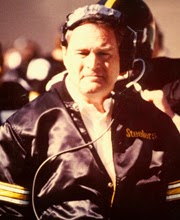
Chuck Noll Hall of Fame
On the surface, Chuck Noll and Vince Lombardi were very different coaches.  Lombardi was hard as nails on his players and he motivated his team with emotional talks and take your breath away rants and raves on the practice field.  Noll was direct and a man of few words.  When Noll did elaborate, sometimes he lost the thread of his message and his players lost the meaning.  Mostly, he kept it simple.

But both coaches spent endless amounts of time to reach the same two objectives: 1. Creating the toughest team in  the NFL.  2. Creating the most fundamentally sound team in the NFL. 

Who could argue that Noll's Steelers and Lombardi's Packers were not both tough and fundamentally sound.  
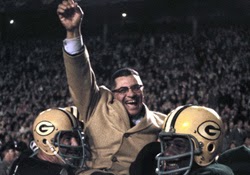
Vince Lombardi Hall of Fame
Lombardi's catch phrase, "winning is everything,"  has often been misunderstood to mean that
winning by any means is acceptable.  But his players would likely tell us that the "any means" had more to do with their training than things they would do to opposing teams.  By sacrificing their bodies and routinely using every ounce of energy in practice, they became a formidable team on the field.  Lombardi sought to have his players better prepared than any other team.

Noll's catchphrase was "whatever it takes." Again, it's easily misunderstood.  Noll expanded on the notion to say that "whatever it takes"  to become the best team  was his meaning.  For Noll, like Lombardi, it was all about sacrifice for the team, work for the team, playing your role for the team.  

For both Lombardi and Noll, their objectives of toughness and fundamentals was demonstrated and forever remembered in two of pro football's greatest highlights.  


Packers' 1967 NFL Championship Game
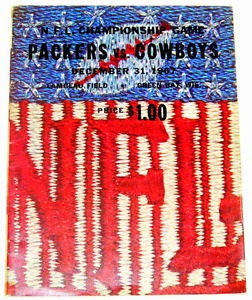
Ice Bowl Program
The Packers played the Dallas Cowboys for the NFL Championship on the last day of the year in 1967.  The Packers had a secret weapon—Mother Nature.  Few NFL games have been so well celebrated and memorialized.  The Packers had seen plenty of cold weather before this game, but the so-called “Ice Bowl” was the start of much of the lore and legend surrounding Lambeau Field.  From this game forward, Green Bay fans would not just tolerate the cold at Lambeau, they would relish their “frozen tundra.”

The Cowboys were leading, 17–14, on the Packers’ frigid home field in the fourth quarter.  With only 4:50 on the clock, Lombardi’s offense looked 68 yards downfield to the goal and began a 12-play drive for the win.  They would need almost every second.   

A determined Starr completed a pass out in the flat to Donny Anderson for a 6-yard gain.  Chuck Mercein found enough running room outside for a first down.  Starr tossed one down the middle to Dowler over the 50-yard line and Cornell Green who was struggling with his footing was able to grab and throw Dowler down hard on the tackle to the frozen ground.  It was nip and tuck all the way.  Anderson received a handoff from Starr, but was tackled in the backfield.  It was second down and 19 yards to go for a first on a field that was quickly becoming an ice skating rink.  Starr looked around and tossed Anderson an outlet pass that the halfback turned into another 12-yard gain.  Starr followed with another short pass to Anderson who gained the first down.  Chuck Mercein was targeted next and after the catch he ran the ball down to the Dallas 11-yard line.  Mercein had the hot hand and took a handoff from Starr and ran it up the middle to the 2-yard line.  Anderson rushed to within inches of the goal and a first down.  The tough, determined Cowboys’ defense stuffed two Donny Anderson drives.  Starr went to the sideline and told Lombardi since the backs were slipping, he would take the ball himself on a wedge play, which normally goes to the fullback.  Lombardi famously responded, “Then do it and let’s get the hell out of here.”  As Starr jogged back on the field, the tension in the stands was almost unbearable.

Starr stood behind center with 13 seconds remaining at the 1-yard line with no time outs.  He raised his hands to quiet the crowd and the ball was snapped on a quick count.  Jerry Kramer jumped out at Jethro Pugh, hitting him low, followed by Packer center Ken Bowman hitting Pugh high.  Cleats scratched on ice and Pugh was driven backwards.  Starr shadowed Kramer and plunged into the end zone for the score.  Mercein, who thought Starr was going to hand off to him, trailed the play and raised his arms in the air so the officials knew he was not pushing Starr into the end zone—an infraction that might have caused the Packers the game.  Millions watching thought Mercein was signaling a score! The fans realized that Starr had scored and in the midst of an arctic field of dreams came the deafening roar of the crowd.  Chandler kicked the extra point. 


Defining Moment for Noll’s Steelers
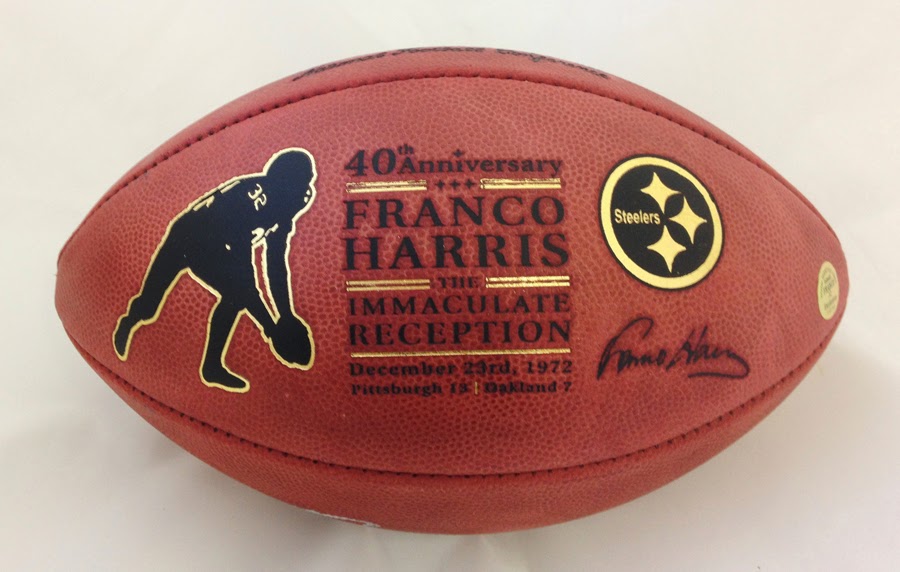
Immaculate Reception Commemorative Football
The defining moment that ended the string of frustration and put the Steelers into a new winning way came at the very end of the divisional playoff game on December 23, 1972.  Pittsburgh had the ball on its own 20-yard line with just 1 minute 20 seconds to go trailing the Oakland Raiders 7–6.  Bradshaw was no miracle worker in those days and five plays later, the Steelers were still 60 yards from pay dirt with only 22 seconds remaining.  Bradshaw threw over the middle to “Frenchy” Fuqua, but Raiders’ defensive back Jack Tatum crashed into Fuqua and the ball with such force that the ball flew backward like it had been redirected by some unknown hand.  Franco Harris grabbed the ball off his shoelaces in stride and eluded tacklers on his way to the end zone for the score and the win.  The play was called the “Immaculate Reception.”  Although the Steelers went on to lose the AFC Championship to the Dolphins, they made an impression with football fans, their competitors, and most importantly, themselves.  They had arrived.  Noll’s Steelers were winners and now with the Immaculate Reception, it seemed like they had fans in high places.

Harris personified what it meant to play fundamentally sound and give it everything he had.  Although he was apparently out of the play, he kept his head in it and when the ball bounced off Tatum  he was able to pick it up and run for the score.  The extra point gave the Steelers a 13–7 victory.

In the waning moments of both games, the players took stock of themselves and played solid fundamental football as a team.

Chuck Noll, the great Steelers' coach and one of the greatest coaches in NFL history died this past week. 


Copyright 2014, Sporting Chance Press

Sporting Chance Press is the publisher of Pillars of the NFL: Coaches Who Have Won Three or More Championships that is available at select bookstores, Amazon, and the publisher's web site.

Weeb Ewbank is a Pillar of the NFL

Weeb Ewbank is one of the coaches who is often overlooked in discussions about the greatest coaches in NFL history.  He was not overlooked in Sporting Chance Press's book, Pillars of the NFL, by Patrick McCaskey, Senior Director of the Chicago Bears. 

I believe there are 2 reasons why Weeb Ewbank is often overlooked in discussions about the greatest coaches in nfl history.

1. When Ewbank won his Championships he had two superstar quarterbacks in Johnny Unitas and Joe Namath.

 2. His overall NFL record was 134-130-7. 

The criteria used in our book  Pillars of the NFL: Coaches Who Won Three or More Championships to rate the top coaches was pure and simple--who won the most championships.  Ewbank won two championships with the Colts--1958 and 1959, and he won with the Jets in 1969 (for the 1968 season). There are only ten coaches to win three or more championships and Weeb Ewbank is one of the them.

Oddly enough, in ESPN's Greatest Coaches in NFL History, Ewbank is not even in the top 20! 

Ewbank signed Johnny Unitas to play in 1956 after the Steelers let him go.  The Steelers are often blamed mercilessly for this, but Unitas was a tall skinny kid who had been overlooked by many other football teams.

Ewbank had just taken over the reigns of the Colts in 1954 -- they were essentially a new team.  The 1953 Colts had replaced the Dallas Texans expansion team that folded after one season. Of the 39 players on the 1953 Colts, Ewbank kept only 19 for 1954.  He had to build from the ground-up. Building an expansion team takes time and it also adds many losses to a coach's career record. 

Once he had Unitas, at least a big part of Ewbank's offense was in good hands.  Working with Unitas must have been a joy in some ways.  He was not only committed to becoming the best, but he was one of those players who had high expectations for his teammates and would work hard with them to help them achieve.  But by the same token, Unitas would not have been an easy man to manage if you were a coach who had a large ego.  But to his credit, Ewbank was results driven and patient.  He didn't seem to mind that Unitas would be the  larger than life figure for the Colts.  Johnny U. was the archetype quarterback, the hardest working man on the field with tremendous leadership qualities. 

Ewbank had to build up what was essentially an expansion team and it took three miserable years for his team to become respectable. In Ewbank's fourth year, the Colts notched a 7-5 season.  In 1958 and 1959, the Colts were the best of the best--the NFL Champions.  Three decent seasons (6-6, 8-6, and 7-7) followed in part because Unitas's interceptions jumped way up, but it also had something to do with the Colts defense that was in need of rebuilding.  Ewbank was fired, but he was welcomed in New York where another new team needed to built from the ground up.

The American League New York Titans football team that began in 1960 was a financial flop and a syndicate of five men purchased the team, changed the name, and hired Weeb Ewbank as coach and general manager. Ewbank was able to pick up some players he knew from his days with the Colts, but he relied mostly on the draft to build a winning team in New York.  His first Jets' season was 1963.  The Jets building process would take a little longer than the Colts although the Jets managed a respectable record before Ewbank's arrival. In Ewbank's third season, Jets President Sonny Werblin signed Joe Namath in New York fashion--Namath received big money and a big car to boot--a Lincoln Continental.  In 1968, the Jets won the Super Bowl and thus the championship.

And although Namath certainly  had much to do with the success of the team, he could be inconsistent.  But it was a tough defense and a ball control conservative offense that would win the day for the Jets in Super Bowl III.  The Jets had a good 10-4 season in 1969, but a tight budget and aging stars helped make the next four seasons half mediocre and half bad.  Namath had more than his share of injuries, but not enough to cause the team to replace him.

When Ewbank retired from Coaching after the 1973 season, the Jets limped along until their next winning season in 1981.  Competing in New York was not easy for the franchise then and is not easy for the Jets now.

Weeb Ewbank had worked for two organizations who were struggling right from the start.  He was able to develop a championship program at each one.  He won three championships and he was an exceptional team-builder.  Weeb Ewbank was one of the greatest coaches in NFL history and he was inducted in the Pro Football Hall of Fame class of 1978.

Copyright 2014, Sporting Chance Press 

Sporting Chance Press publishes fine books on sports that easily accessible for all readers and entertaining to read.  Take a look.